Faith & Film · August 8, 2026 · 16 min read · FourBoys Entertainment
Film Production Los Angeles FAQ: What Productions Actually Need to Know
Film Production Los Angeles FAQ: What Productions Actually Need to Know
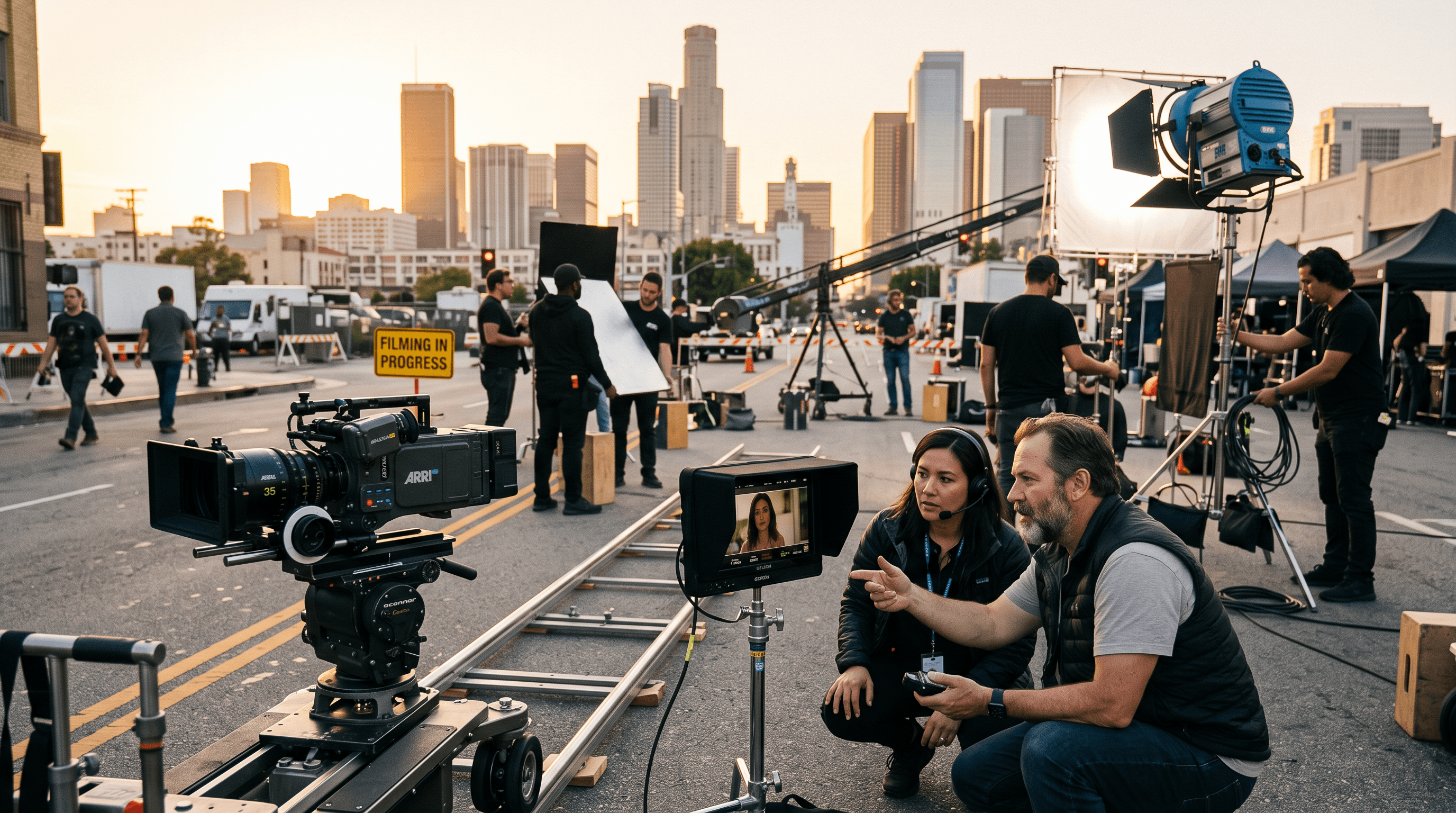
Film production in Los Angeles operates at a scale unlike any other city, with hundreds of active permits issued each week and a crew workforce built across multiple generations of craft workers. This FAQ answers the questions production professionals, independent filmmakers, and brand producers ask most often before starting a project in LA. Every answer draws on current permit authority guidelines and publicly documented industry standards.
Quick Answer: Film production in Los Angeles requires a FilmLA permit for most public locations, general liability insurance with a minimum $1 million per occurrence, union coordination through SAG-AFTRA and IATSE for covered productions, and a LADOT-approved traffic management plan for any street work. The California Film Tax Credit (20% to 25% on qualifying projects) is the primary state incentive for keeping large productions in the region.
Productions filming on public streets must submit a traffic management plan to FilmLA and LADOT before any vehicle moves. That requirement reflects real traffic conditions: Los Angeles recorded 29,883 crashes in 2025, injuring 17,103 people, according to the California Highway Patrol Crash Records Information System (CHP CCRS, data.ca.gov). The breakdown by collision type shows why specific production scenarios trigger specific permit requirements.
| Collision Type | 2025 LA Crashes | Injured | Production Implication |
|---|---|---|---|
| Rear-End | 10,114 | 6,415 | Rolling picture vehicles require buffer lanes and follow cars |
| Side Swipe | 9,102 | 2,957 | Multi-lane shots require dedicated closures (32% injury rate) |
| Hit Object | 3,715 | 1,262 | Base camp and equipment vehicles must sit behind active traffic control |
| Broadside | 3,011 | 3,326 | Intersection shots carry the highest injury-per-crash ratio; full closures required |
| Vehicle/Pedestrian | 1,566 | 1,468 | Crowd and background artist scenes require separate pedestrian control plans |
Sources
-
FilmLA - Official film permit office for the City and County of Los Angeles; administers permits for public locations and publishes annual production statistics.
-
California Film Commission (film.ca.gov) - State authority for the California Film Tax Credit Program; publishes approved project lists and eligibility guidance.
-
CHP Crash Records Information System, data.ca.gov - Source for 2025 Los Angeles crash and injury statistics cited in this post; updated daily.
-
IATSE (iatse.net) - International Alliance of Theatrical Stage Employees; primary below-the-line union covering camera, grip, electric, and art department in Los Angeles.
How Does the FilmLA Permit Process Work?
FilmLA is the non-profit organization contracted by the City and County of Los Angeles to manage the film permit process. A standard application requires production dates, location details, a description of what will be filmed, proof of general liability insurance at $1 million per occurrence minimum, and a traffic management plan for any street work. Standard processing runs three to five business days. Complex permits involving street closures, stunts, or pyrotechnics typically take two to three weeks because they require coordination with LAPD, LAFD, LADOT, and sometimes CalTrans.
Filming on private property with written owner permission is generally exempt from the FilmLA permit requirement, as is filming inside a studio on its own lot. State parks and national park land require permits directly from California State Parks or the National Park Service, with FilmLA facilitating coordination in many cases.
What Unions Govern Film Productions in Los Angeles?
Most professional productions in Los Angeles that meet budget thresholds operate under collective bargaining agreements with the major guilds. SAG-AFTRA covers on-screen performers. The Directors Guild of America covers directors, assistant directors, and production managers. The Writers Guild of America covers screenwriters and TV staff writers. IATSE covers below-the-line crew across departments including camera, grip, electric, art department, wardrobe, and post-production. Teamsters Local 399 covers transportation coordinators, drivers, and location managers.
Productions below certain budget thresholds can access modified union agreements. SAG-AFTRA offers Ultra Low Budget, Modified Low Budget, and Low Budget agreements with adjusted minimums. Non-union productions are not bound by guild minimums but face limits on casting SAG-AFTRA members, who may work under waivers only in limited circumstances.
Frequently Asked Questions
Do I need a permit to film in Los Angeles?
Most filming on public property in Los Angeles requires a FilmLA permit. This covers public streets, sidewalks, parks, and city-owned buildings. Filming on private property with written permission from the owner is generally exempt from the FilmLA process, though noise, parking, and signage regulations still apply to all productions.
How long does it take to get a film permit in Los Angeles?
Standard FilmLA permits for straightforward locations take three to five business days. Permits involving street closures, stunts, pyrotechnics, fire effects, or large crowds of background actors take two to three weeks due to multi-agency coordination requirements with LAPD, LAFD, LADOT, and in some cases CalTrans.
How much does a film permit cost in Los Angeles?
FilmLA charges a permit processing fee based on production type, plus separate location fees set by the city department or managing agency for the specific location. Student and non-commercial permits carry reduced processing fees. The current fee schedule is available at filmla.com. Budget separately for required off-duty LAPD officers at street closures, billed at the officer's overtime rate.
What insurance does a film production in Los Angeles need?
FilmLA requires proof of commercial general liability insurance with a minimum $1 million per occurrence and $2 million aggregate, naming the City of Los Angeles as additional insured. Productions using specialty vehicles, aircraft, watercraft, or pyrotechnics need additional endorsements. Most professional productions also carry workers' compensation, equipment insurance, and errors and omissions (E&O) coverage for completed projects.
What is FilmLA and is it a government agency?
FilmLA is a non-profit organization, not a city department. It operates under contract with the City and County of Los Angeles to administer the film permit process. Permits issued through FilmLA carry legal authority backed by city ordinance. FilmLA also tracks production volume and publishes annual economic impact reports.
How do I find out what is filming near me in Los Angeles?
FilmLA sends neighborhood filming notices to residents near approved permit locations, typically 24 to 48 hours in advance. The FilmLA website and app allow public searches by neighborhood and date range. Productions filming on private property are not required to post public notice, so visible equipment on a private lot may not appear in the FilmLA system.
What is the real path to getting hired in LA film production without existing connections?
Most entry-level hires in LA production come through set PA and office PA applications submitted directly to production companies and through job boards including ProductionBeast, Mandy.com, and staff.me. Film school alumni networks generate early referrals for many entry-level workers. Building a track record through reliable day-call work, then getting referenced by a department coordinator, is the established route to repeat hires and eventual union membership.
Can I film in Griffith Park or other Los Angeles County parks?
Filming in LA County parks, including Griffith Park, requires a permit from LA County Parks and Recreation, coordinated through FilmLA. The county sets its own location fees and restrictions on access hours. Certain areas within Griffith Park have additional restrictions during peak visitor times. The county permit is separate from the FilmLA processing fee.
What is the difference between a SAG-AFTRA and non-union production in Los Angeles?
SAG-AFTRA productions sign a collective bargaining agreement that sets performer minimums (scale rates), working condition standards including turnaround and meal periods, and residual payment structures for distribution windows. Non-union productions are not bound by these minimums and negotiate directly with performers. Active SAG-AFTRA members who work on non-union productions without a waiver violate their membership terms.
Does the California Film Tax Credit apply to commercials?
No. The California Film Tax Credit Program 3.0 does not cover commercials or advertising content. It applies to feature films, TV pilots, recurring and limited TV series, and non-theatrical projects over $1 million in budget. Separate local municipality incentives occasionally apply to commercial work, but vary by city and are not state-administered.
How do I get approval to fly a drone for a film production in Los Angeles?
Drone filming for commercial purposes in Los Angeles requires FAA Part 107 remote pilot certification, a FilmLA permit for public locations, and FAA LAANC authorization for flights in controlled airspace, which covers most of the LA basin near LAX, Burbank, Van Nuys, and Hawthorne airports. Flights over moving vehicles or people require additional FAA waivers. Many residential areas also have HOA or building-level restrictions on flights over private property.
What are the noise rules for night filming in Los Angeles residential neighborhoods?
Los Angeles city ordinance restricts amplified noise in residential areas after 10:00 PM. Night shoots in residential neighborhoods require a noise management plan as part of the FilmLA permit application. Productions typically agree to limit generator noise, PA system volume, and vehicle idling after specified cutoff times. Permit violations including noise complaints can result in on-site permit suspension by LAPD.
Why has filming in Los Angeles become harder for small productions in recent years?
Several pressures have increased friction for independent productions in LA. Location fees have risen as property owners gained awareness of their market leverage. Insurance minimums have increased industry-wide. Crew day rates have risen during high-volume production seasons when multiple large projects compete for the same labor pool. Permit processing timelines for complex locations have also lengthened due to higher application volume and multi-agency review requirements.
What is a traffic management plan and who has to approve it?
A traffic management plan (TMP) documents proposed lane closures, detour routes, signage positions, personnel assignments, and closure hours for any filming that affects public street traffic. FilmLA coordinates TMP submission to LADOT for review and approval. For work on state highways, CalTrans also reviews. Given that Los Angeles recorded 29,883 crashes and 17,103 injuries in 2025 (CHP CCRS, data.ca.gov), LADOT scrutinizes intersection work and peak-hour closures closely.
Can a non-California company claim the California Film Tax Credit?
A non-California company producing a qualifying project in California can apply for the credit. The credit offsets California income tax liability. Companies with no California nexus typically form a California production entity for the project to establish the tax connection. The California Film Commission publishes entity eligibility guidelines at film.ca.gov and provides formal guidance on request.
Can I film at the Hollywood Sign or other iconic Los Angeles landmarks?
The Hollywood Sign is on property managed by the Hollywood Sign Trust; filming at or near the sign requires permission from the Trust. Most productions film the sign from public viewpoints such as Griffith Observatory or Lake Hollywood Park, which require FilmLA permits. Other iconic locations including the Getty Center, Union Station, and Griffith Observatory have their own permit and fee structures set by the managing institution.
What neighborhoods in Los Angeles are most often used for film production?
According to FilmLA annual production reports, the San Fernando Valley (Burbank, Sherman Oaks, Woodland Hills) and West LA (Santa Monica, Culver City) consistently rank among the highest-volume filming neighborhoods. Downtown LA and Hollywood attract urban exterior work. Studio City and Sherman Oaks residential streets frequently serve as suburban stand-ins due to proximity to studio lots. FilmLA publishes neighborhood-level production data in its annual reports.
Looking for a Production Partner in Los Angeles?
FourBoys Entertainment is a Los Angeles-based film production company that handles permit coordination, crew, and logistics for projects from development through delivery. If you are planning a film, branded content, or independent production in LA, contact the FourBoys team to discuss your project.
Contact FourBoys Entertainment
Disclaimer: This FAQ provides general information about film production in Los Angeles. Permit fees, union agreements, tax credit programs, and regulations change over time. Consult FilmLA directly at filmla.com, the California Film Commission at film.ca.gov, and qualified legal and financial advisors for guidance specific to your project and budget.